
Hurricane shutters all do one job — stop wind-borne debris from breaking a window or door and pressurizing your home — but they do it in very different ways, at very different prices, with very different day-to-day trade-offs. Choosing the right type matters more than choosing a brand. This guide compares the six main types of hurricane shutters — storm panels, accordion, roll-down, Bahama, hurricane fabric, and colonial — so you can match the right system to your budget, your wind zone, and how you actually live in your home.
Hurricane Shutters Wholesale manufactures all six, built to your exact opening size and shipped worldwide factory-direct, so what follows reflects where each type genuinely fits — not a pitch for one product.
Hurricane shutter types at a glance
| Type | How it works | Cost for a 24″ × 36″ window | HVHZ option? | View when closed | Best for |
|---|---|---|---|---|---|
| Storm panels | Removable aluminum, steel, or clear panels bolted over the opening before a storm | from $46.40 | Yes | Blocked (clear polycarbonate lets light in) | Budget protection, seasonal use, DIY |
| Hurricane fabric | Lightweight woven panels attach over the opening; store in a bag | from $46.58 | Yes | Blocked (lets some light through) | Easy handling, large openings, DIY |
| Colonials | Louvered panels hinged at the sides close over the window | from $258.00 | Yes (impact) | Partial (louvers) | Curb appeal + protection |
| Accordions | Stays mounted; unfolds from the sides and locks shut in seconds | from $327.18 | Yes | Blocked | Fast deployment, no storage, rentals |
| Bahamas | Top-hinged; props out for shade, lowers flat for storms | from $435.00 | Yes (impact) | Partial (angled) | Shade + curb appeal + protection |
| Roll-downs | Slatted curtain rolls down from a housing, by hand or motor | from $568.20 | Yes | Blocked | One-touch protection, security, high-end homes |
Prices shown are the lowest starting price for a 24″ × 36″ opening. Every shutter is built to your exact opening, so your price depends on size, material, and options — price your own window instantly with any configurator below. HVHZ approval is granted per product: not every size or model in a family carries it, so confirm the Florida approval number on the specific product you choose.
Storm panels
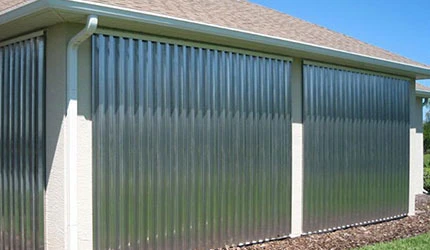
Storm panels are the original — and still the most affordable — form of hurricane protection. They're flat, overlapping panels in .050 aluminum, 24- or 28-gauge galvanized steel, or clear polycarbonate that bolt over your windows and doors ahead of a storm and come down afterward for storage. With no housing or mechanism, you get the most protection per dollar, and clear polycarbonate panels let daylight in while they're up.
The trade-off is labor: panels go up and come down by hand for each storm, and you need somewhere to store them. Panels are cut to your exact opening from 12 to 150 inches, and HVHZ-approved options are available for High-Velocity Hurricane Zones. They're the natural pick for budget-minded and seasonal buyers, and they're DIY-friendly.
Shop storm panel parts or get instant pricing on made-to-order storm panels.
Hurricane fabric (AstroGuard)
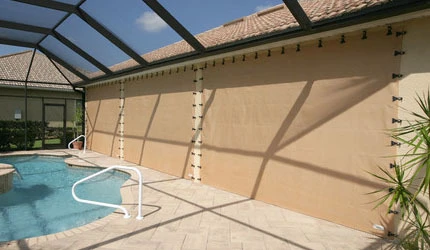
Hurricane fabric is the newest category and the easiest to handle. Instead of metal, it uses strong, lightweight woven panels — we carry AstroGuard — that attach over the opening to stop wind-borne debris, then roll up into a small bag for storage. At a small window it costs essentially the same as metal panels, so the easier handling comes at no premium.
One person can deploy fabric over large openings that would take two people to cover with metal panels, and it weighs a fraction as much. It lets some light through, won't dent, and is a favorite for big spans like lanais, garages, and double doors. HVHZ-approved options are available. Like panels, fabric goes up per storm and stores between them, and it's genuinely DIY-friendly.
Ready to put panels up? See our step-by-step storm panel installation guide.
Explore hurricane fabric or get instant pricing.
Colonial shutters
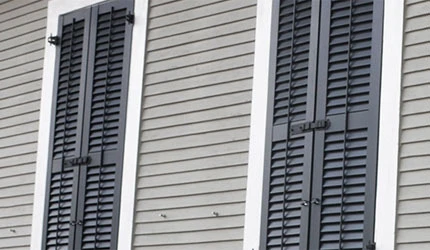
Colonial shutters are the decorative cousin of the Bahama. Two louvered panels hinge at the sides of the window and stay open against the wall as an architectural accent; when a storm comes, you swing them closed and secure them with a center bar.
They give a home a finished, traditional look every day and storm protection when it's needed. Our Bertha™ Colonial is impact-rated with an HVHZ-approved option, plus a non-HVHZ option for standard wind zones. On smaller windows colonials are often the most affordable of the permanently-mounted types — worth pricing against an accordion before you decide.
Explore colonial shutters or get instant pricing.
Accordion shutters

Accordion shutters stay mounted beside each opening year-round and unfold from both sides to lock shut in seconds — no ladders, no storage, nothing to carry. That speed makes them one of the most popular choices for primary homes, vacation properties, and rentals, where a storm can arrive with little notice.
They lock from the inside or outside for everyday security and close partway for shade or privacy. Our Bertha HV™ aluminum accordion meets the Florida Building Code for both HVHZ (Miami-Dade and Broward) and non-HVHZ locations, plus TDI, IBC, and IRC standards, and comes in white, ivory, beige, and bronze. Versus panels, the trade-off is a higher up-front cost and a visible track above and below the opening.
Explore accordion shutters and parts or get instant pricing.
Bahama & Bermuda shutters
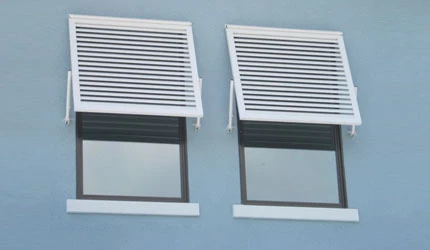
Bahama shutters — also called Bermuda shutters; they're the same thing — hinge at the top of the window and prop outward on an arm, throwing shade and adding a coastal look while they sit open all season. When a storm approaches, you release the arm and the shutter lowers flat against the opening for protection.
That dual role — everyday shade and curb appeal plus storm defense — is the draw, and by keeping sun off the glass they can meaningfully cut cooling costs. Impact-rated and HVHZ-approved options are available. Because they're partly decorative, they're priced above bare panels and are usually chosen where looks matter as much as protection.
Explore Bahama & Bermuda shutters or get instant pricing.
Roll-down (roll-up) shutters
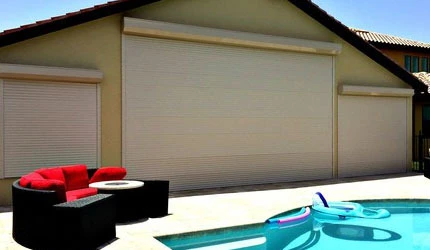
Roll-down shutters — also called roll-up or rolling shutters — are the premium option. A slatted curtain lives in a compact housing above the opening and rolls down over the glass on command, with a hand crank or a motor and remote. Nothing is faster: motorized roll-downs close a whole house at the push of a button, which is why they're favored for high-end homes and for anyone who can't manage panels.
They also add daily benefits panels can't — security, insulation, room-darkening, and noise reduction. Our Bertha™ roll shutters offer HVHZ-approved options, manual or motorized. The trade-off is price: roll-downs are the most expensive type, and motorization adds to that.
Explore roll-down shutters and parts or get instant pricing.
How much do hurricane shutters cost?
The table above shows what a small 24″ × 36″ window costs in each type — but there's no single price for a house, because every shutter is built to the exact size of your opening. Four things drive the cost:
- Size and quantity — bigger openings and more windows mean more material.
- Material and type — storm panels and hurricane fabric are by far the most affordable; the permanently-mounted types cost more, with roll-downs the most expensive, especially motorized.
- Wind rating — HVHZ-approved products use heavier construction than standard-zone products.
- Options — motors, color, and hardware add to roll-downs and decorative shutters.
Rather than guess from a range, you can see a real number in a minute: every product line has a Get Instant Pricing configurator — enter your opening sizes and options and it prices the exact shutter, factory-direct with no installer markup. Because Hurricane Shutters Wholesale manufactures and ships worldwide, you pay wholesale for the same approved products a contractor would install.
How to choose the right hurricane shutter
Work from four questions:
- What's your budget? Storm panels or hurricane fabric protect the most window for the least money.
- How fast do you need to close up? For a rental, a second home, or if you simply don't want to handle panels, accordions or motorized roll-downs deploy in seconds.
- Are you in an HVHZ zone? Miami-Dade, Broward, and other high-velocity zones require HVHZ-approved products — confirm the specific model you choose carries that approval.
- Do looks matter? Bahama and colonial shutters double as year-round architectural features and shade; roll-downs disappear into a housing when open.
Many homeowners mix types — panels or fabric on the back of the house, accordions or roll-downs where speed and looks count. For entry doors with glass, a Front Door Shield adds protection without covering the whole door.
Hurricane shutter FAQ
What is the cheapest type of hurricane shutter?
Storm panels and hurricane fabric are the most affordable, because they have no permanent mechanism or housing. Both protect large openings for the least cost, and both are put up before a storm and stored afterward.
Which hurricane shutters are rated for high-velocity (HVHZ) zones?
Every type offers HVHZ-approved options — panels, accordion, roll-down, Bahama, fabric, and colonial. Approval is granted per product, so confirm the specific model and size you choose carries a Florida HVHZ approval number before you buy.
Are Bahama and Bermuda shutters the same thing?
Yes. "Bahama" and "Bermuda" are two names for the same top-hinged shutter that props out for shade and lowers for storm protection.
What is the difference between roll-down and roll-up shutters?
They're the same product — a slatted curtain that rolls down over the opening from a housing above it. "Roll-down" describes closing it and "roll-up" describes opening it; both refer to a rolling shutter, manual or motorized.
Do hurricane shutters have to be professionally installed?
Not necessarily. Storm panels and hurricane fabric are designed for homeowners to put up and take down themselves. Permanently-mounted systems — accordion and roll-down — are mounted once and then operated by hand or motor. Hurricane Shutters Wholesale builds each shutter to your exact size and ships it to you; mounting is handled by you or your own contractor.
Compare prices and order
Once you know the type that fits, price it in a minute. Each configurator builds your shutter to size and shows the cost instantly, factory-direct and shipped worldwide: