
Quick answer: The 2" or 2.25" (2¼") in a storm panel’s name is the height of its ribs. Lay one panel flat on the ground, ribs up, and measure from the ground to the top of a rib. It will read 2 inches or 2¼ inches. That is the whole difference you can see.
Why it matters: if you are buying panels to nest with shutters you already own, buy the same size you have. A 2" panel only nests with 2" panels and only fits a 2" header; a 2¼" panel only nests with 2¼" panels and only fits a 2¼" header. If you are buying a whole new set, either size works. Pick the panel with the code approval your building needs, then choose by material and price.
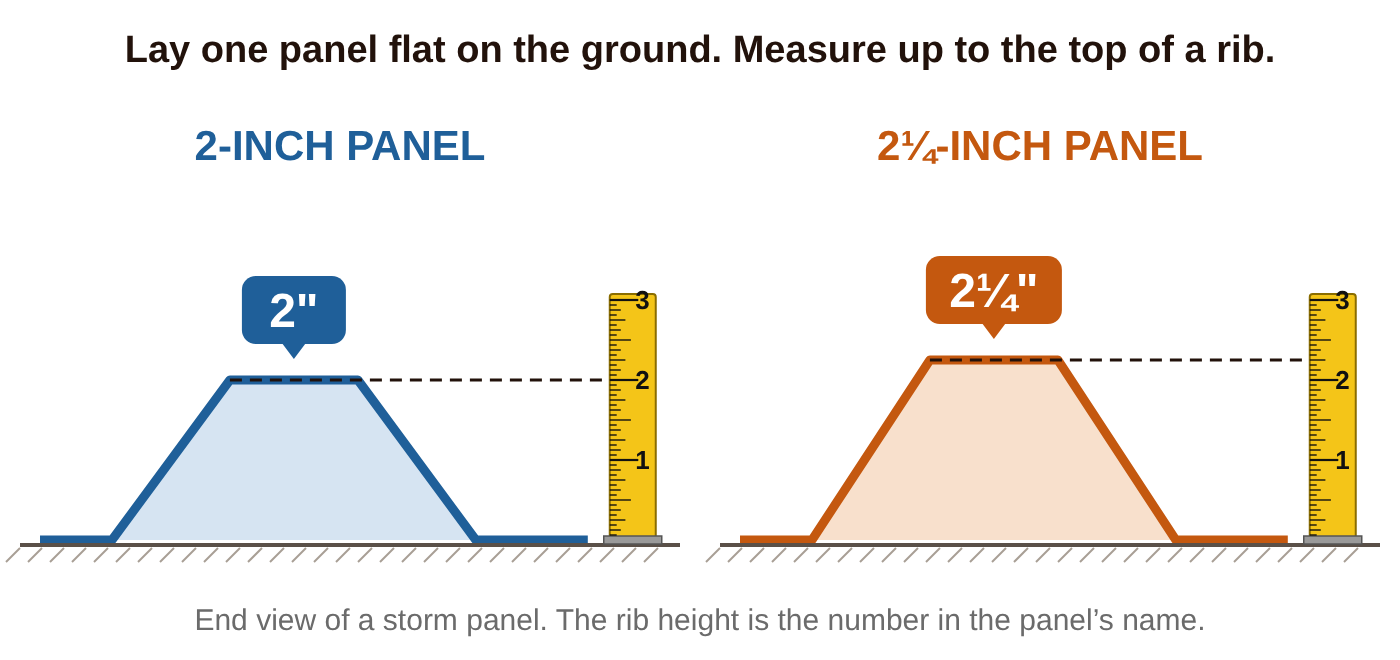
What does 2" or 2.25" mean on a storm panel?
Storm panels are corrugated: raised ribs that stiffen the panel, with flat strips between them where the keyhole slots are. The 2" or 2¼" is how tall those ribs are, also called the panel’s rise, profile or depth.
It is not the thickness of the metal, the width of the panel or its length:
- The metal thickness is the other number in the name: .050 aluminum, 24-gauge or 28-gauge steel, .030 steel.
- The coverage is the same for both sizes. Each full panel covers 12 inches of the opening once the panels overlap, and a half panel covers about 6 inches. The 2¼" panel is about an inch wider overall, but the extra width is overlap.
- The length is whatever you order. We cut every panel to your opening, from 12" to 150" in 1-inch steps (the 2" clear panel goes up to 142").
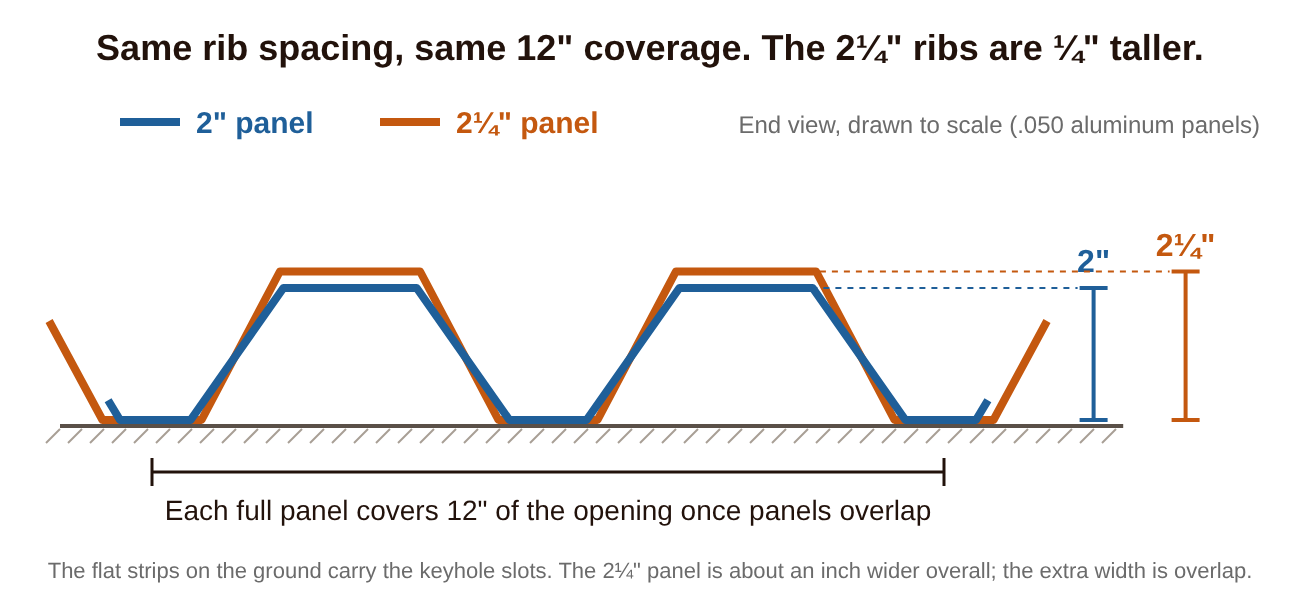
A quarter of an inch is easy to miss by eye. Side by side, a 2" panel and a 2¼" panel look the same:
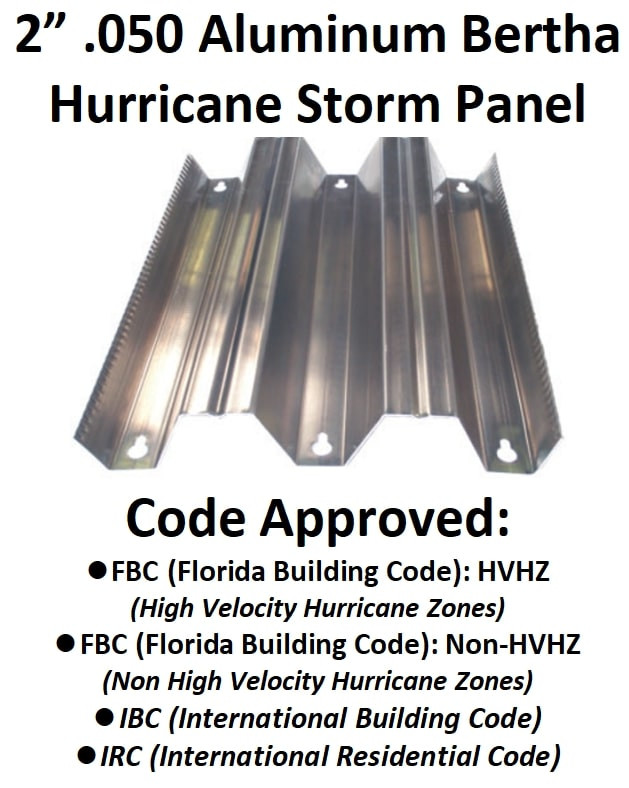
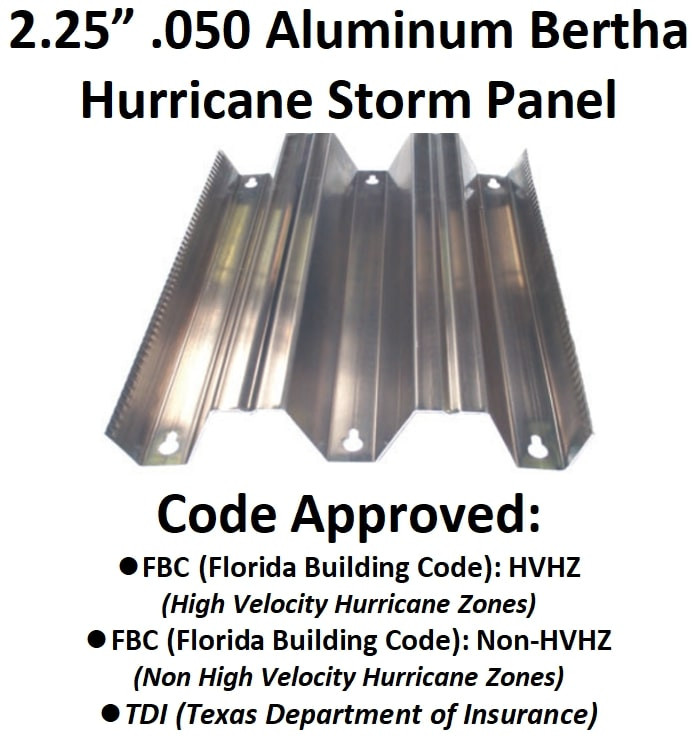
That is why the tape measure is the only reliable test.
How to tell if your storm panels are 2" or 2.25"
- Take one panel down, or pull one out of storage.
- Lay it flat on a level floor or driveway, ribs up, so the flat strips with the keyhole slots sit on the ground.
- Stand a tape measure next to a rib, or lay a straightedge across the tops of the ribs, and measure from the ground up to the top of the rib.
- Read it. 2 inches = 2" panels. 2¼ inches = 2¼" (2.25") panels.
Measure a rib, not the bent edge at the side of the panel, and measure a second rib if the panel is dented.
Panels stored away? Measure the header on the house instead. Look up into the channel the panels slide into and measure the gap between its two legs: about 2 inches on a 2" header and about 2⅜ inches on a 2¼" header (our Bertha headers measure 2.00" and 2.34" inside).
Still not sure? Send us a photo of a panel lying flat with a tape measure against a rib, or a photo of your header, and we’ll tell you which size you have. Contact us or call 561-626-8708.
Adding to shutters you already have? Buy the same size
Storm panels are made to nest. On the wall, each panel overlaps the one beside it, rib over rib. In storage, a stack of panels nests together, about 7 panels to the inch. That only works when every panel has the same profile. A 2¼" panel will not nest with 2" panels, and a 2" panel will not nest with 2¼" panels.
The header decides it too. The panels slide up into a header that is made for one size:
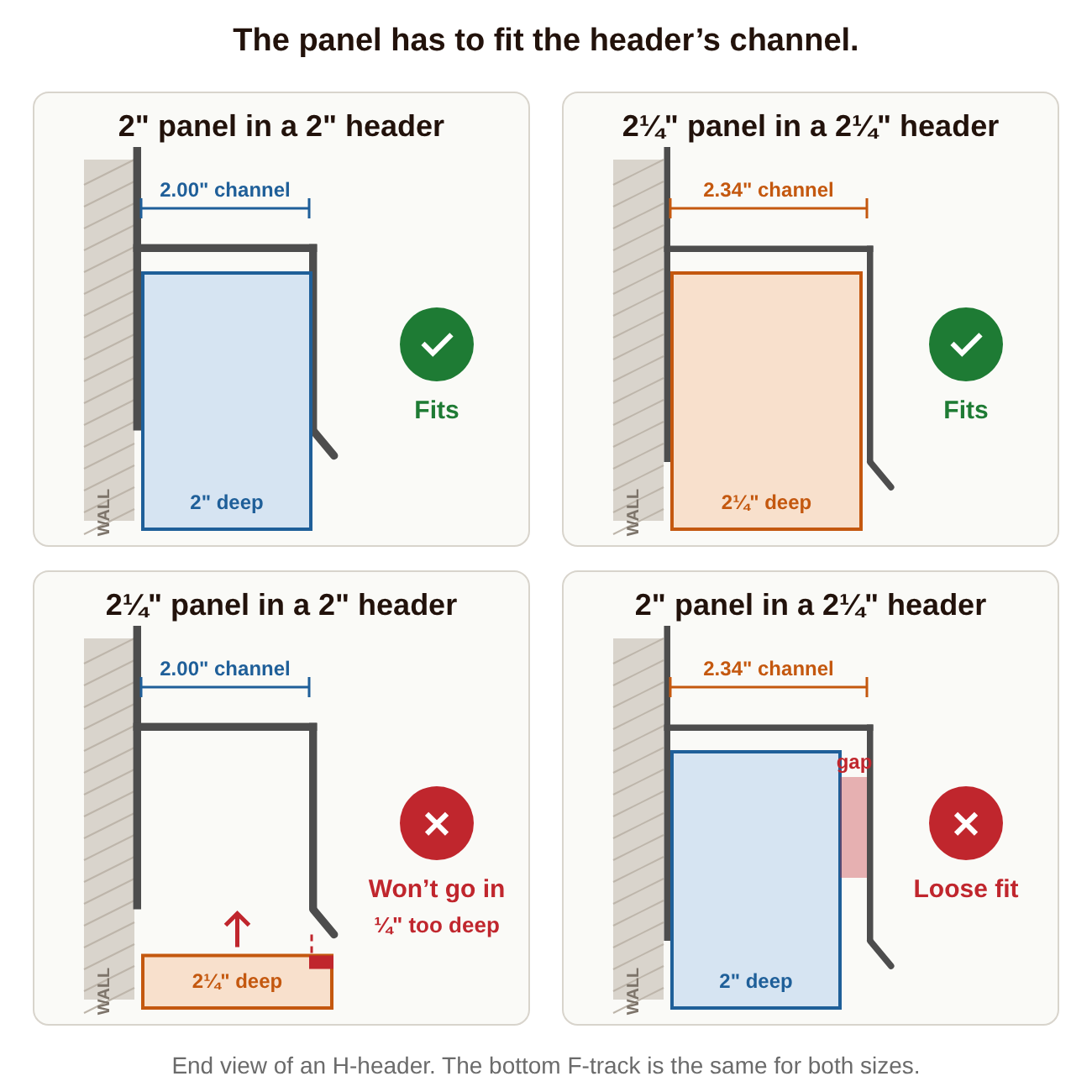
- Replacing a lost or damaged panel, or adding panels to an opening: buy the size you already have.
- Adding clear panels to your metal panels: clear panels go in the same opening and overlap on top of the metal panels, so they must be the same size too. A 2" metal set needs 2" clear panels. See our clear Lexan panel guide for where clear panels are approved.
- Protecting a window that has no shutters yet: you can use either size on that opening, with its own matching header. Staying with one size keeps every panel in your garage nesting together.
Buying a new set? Pick by code approval, then price
If you are not matching existing panels, neither size is better. Start with the approval your building needs. In Florida, homes in Miami-Dade and Broward counties are in the High Velocity Hurricane Zone (HVHZ) and need an HVHZ-approved panel; the rest of the state is Non-HVHZ. Your local building department has the final say. Then choose by material, look and price.
| Panel | Rib height | Material | Approval | Price per foot* |
|---|---|---|---|---|
| 2" 28-gauge galvanized steel | 2" | Steel | HVHZ and Non-HVHZ | $6.99 |
| 2" 24-gauge galvanized steel | 2" | Steel | Non-HVHZ only | $7.29 |
| 2" .050 aluminum | 2" | Aluminum | HVHZ and Non-HVHZ | $8.99 |
| 2" clear polycarbonate | 2" | Clear Lexan | HVHZ and Non-HVHZ | $12.99 |
| 2¼" .030 galvanized steel | 2¼" | Steel | HVHZ and Non-HVHZ | $8.49 |
| 2¼" .050 aluminum | 2¼" | Aluminum (white or mill finish) | HVHZ and Non-HVHZ | $9.49 |
| 2¼" clear polycarbonate | 2¼" | Clear Lexan | Non-HVHZ only | $12.99 |
*List prices as of November 2026. Panels 120" and longer carry an overlength fee. Approvals are the Florida Building Code zones listed on each product page.
- Want clear panels in Miami-Dade or Broward? Only the 2" clear panel is HVHZ-approved, so build a 2" system and mix 2" clear panels in where you want daylight.
- Want white panels? The 2¼" .050 aluminum panel comes in white as well as mill finish.
- Lowest price per foot? The 2" 28-gauge galvanized steel panel, which is also HVHZ-approved.
Whichever you pick, order the header made for that size. Our storm panel instant pricing tool works out the number of panels, their length and the headers and tracks for each opening.
Is a 2.25" storm panel stronger than a 2" panel?
Not everywhere. We checked the Florida product approvals for our two .050 aluminum panels, the one pair we sell in the same metal and thickness in both sizes. The answer depends on whether you are inside the High Velocity Hurricane Zone (Miami-Dade and Broward).
Outside the HVHZ, it is close to a tie. Hung from an H-header, the two panels are approved for nearly the same lengths at every wind load. The 2¼" panel gets a few more inches at higher loads; the 2" panel is approved for much higher loads on short panels.
| Wind load (design pressure, both directions) | 2" .050 aluminum: longest panel | 2¼" .050 aluminum: longest panel |
|---|---|---|
| 30 psf | 13'-0" | 12'-11" |
| 40 psf | 11'-3" | 11'-2" |
| 50 psf | 9'-0" | 9'-4" |
| 60 psf | 7'-6" | 7'-9" |
| 70 psf | 6'-5" | 6'-8" |
| 80 psf | 5'-8" | Not rated |
| 90 psf | 5'-0" | Not rated |
Non-HVHZ approvals, panels hung from an H-header. The 2" panel is rated up to +90/−130 psf (4'-1½" long at the top load); the 2¼" panel up to +75/−80 psf.
Inside the HVHZ, the 2¼" panel is rated for more wind on 8- to 10-foot panels and can sit much closer to the glass. The 2" panel is the only one of the two approved past 10 feet.
| Panel length | 2" .050 aluminum (HVHZ) | 2¼" .050 aluminum (HVHZ) |
|---|---|---|
| 8 ft | 61 psf, 6" from the glass | +65/−77 psf, 2¼" from the glass |
| 9 ft | 51 psf, 8¾" from the glass | +65/−77 psf, 3-11/16" from the glass |
| 10 ft | +41/−42 psf, 8¾" from the glass | +62/−73 psf, 3⅝" from the glass |
| 11 ft | 35 psf, 8¾" from the glass | Not approved |
| 12 ft | 30 psf, 8¾" from the glass | Not approved |
HVHZ approvals, best mounting type in each. Glass gaps for the 2" panel apply up to 30 feet above the ground (it needs 1¼" to 3½" above that). Your installer and building department apply the full approval.
That gap from the glass matters because every panel bends when it is hit. Each approval sets how far the panel must stay off the glass so it can bend without reaching it. In the HVHZ approvals, the 2¼" aluminum panel needs less than half the gap the 2" panel needs on an 8- to 10-foot opening, which helps on windows set close to the face of the wall. Outside the HVHZ, both approvals call for a 1-inch minimum gap.
One thing the extra quarter inch does not do is move the panel farther from your window. The back of the panel sits on the header and track in the same place for both sizes; the extra ¼" is on the outside. The gap comes from how the panel is mounted: the wall, how far the window is set back, and any build-out on the header and track.
Bottom line: neither size is stronger everywhere. Choose by the approval your building needs and the length of your panels.
Headers and tracks for each size
| Part | 2" panels | 2¼" panels |
|---|---|---|
| H-header (mounts on the wall above the opening) | 2" H-header | 2¼" H-header |
| U-header (mounts to the ceiling or soffit) | 2" U-header | 2¼" U-header |
| Inside width of the header channel | 2.00" | 2.34" |
| Header length for 1 panel | 14⅜" | 15" |
| Each extra half panel adds | 6" | 6" |
| Header length for 4 panels | 50⅜" | 51" |
| Bottom F-track | Same F-track for both sizes | Same F-track for both sizes |
See all headers and tracks, and our storm panel installation guide for how the header, track and panels go together.
Frequently asked questions
What is the difference between 2" and 2.25" storm panels? The number is the height of the panel’s ribs. Lay the panel flat and a 2" panel stands 2 inches off the ground; a 2.25" (2¼") panel stands 2¼ inches. The two sizes use different headers and do not nest with each other. Both cover about 12 inches of width per panel, both are cut to length, and both come in approved aluminum, steel and clear versions.
How do I know if my hurricane panels are 2" or 2.25"? Lay one panel flat on a level floor with the ribs up and measure from the floor to the top of a rib. If it reads 2 inches, you have 2" panels; if it reads 2¼ inches, you have 2.25" panels. If your panels are put away, measure the gap inside the header the panels slide into: about 2 inches on a 2" header, about 2⅜ inches on a 2.25" header.
Can I mix 2" and 2.25" storm panels? Not on the same opening. Panels overlap and nest with the panel next to them, and they hang from a header sized for one panel. If you are adding panels to a set you already own, buy the same size you have. Different windows can use different sizes, as long as each opening uses one size and its matching header.
Do 2" and 2.25" storm panels use the same header? No. A 2" H-header has a 2.00" channel and a 2.25" H-header has a 2.34" channel. A 2.25" panel will not go into a 2" header, and a 2" panel sits loose in a 2.25" header. U-headers are also sold by size. The bottom F-track is the one part that works with both.
Is a 2.25" storm panel stronger than a 2" panel? Not everywhere. Comparing the approvals for our 2" and 2.25" .050 aluminum panels: outside the High Velocity Hurricane Zone, both are approved for nearly the same panel lengths at every wind load, and the 2" panel is approved for higher loads on short panels. Inside the HVHZ (Miami-Dade and Broward), the 2.25" panel is rated for more wind on 8- to 10-foot panels and needs less space from the glass, but only the 2" panel is approved past 10 feet. Choose by the approval your building needs and your panel lengths.
Does a 2.25" panel sit farther from the window than a 2" panel? No. The back of the panel sits on the header and track in the same place for both sizes, so the extra quarter inch is on the outside of the panel. The gap between the panel and the glass comes from the wall, how far the window is set back, and any build-out on the header and track. Each product approval sets a minimum gap, based on the panel’s length and the wind load.
How far does a storm panel have to be from the glass? It depends on the panel’s approval. Outside the High Velocity Hurricane Zone, our 2" and 2.25" .050 aluminum panels both call for at least 1 inch. Inside the HVHZ, the 2" aluminum panel needs 6 to 8¾ inches on panels up to 12 feet (installed up to 30 feet above the ground), and the 2.25" aluminum panel needs 2¼ to 3⅞ inches on panels up to 10 feet.
Can I add clear panels to my existing metal storm panels? Yes, if they are the same size. Clear panels go in the same opening as metal panels and overlap on top of them, so a 2" metal set needs 2" clear panels and a 2.25" set needs 2.25" clear panels. Only the 2" clear panel is approved for High Velocity Hurricane Zones (Miami-Dade and Broward). Every clear panel must be reinforced with sidewalk bolts and 7 clear panel washers.
What do .050, 24-gauge and 28-gauge mean on a storm panel? They describe the thickness of the metal, not the rib height. .050 means aluminum 0.050 inch thick. Gauge is how steel is sized: the higher the gauge number, the thinner the steel, so 28-gauge is thinner than 24-gauge. The rib height (2" or 2.25") is a separate measurement.
What size storm panels do I need? Every panel is cut to the length you order, from 12" to 150" in 1-inch steps (up to 142" for the 2" clear panel; lengths of 120" and over carry an overlength fee). Each full panel covers about 12 inches of the opening’s width once panels overlap, and half panels cover about 6 inches. Our instant pricing tool works out the number of panels and their length from your opening’s width and height.
Which size should I buy for a new installation? Either one. If you are not matching existing panels, pick the panel that has the code approval your building needs (HVHZ in Miami-Dade and Broward, Non-HVHZ elsewhere in Florida), then choose by material, look and price, and order the header made for that size.
Need your panels put up or installed? Post the job free on Hurricane Handyman for fixed-price quotes from local handymen and contractors.
Ready to order? Shop storm panels, or get a price for each opening with the instant pricing tool.